← Strategic Diagnosis  ·  The method

Four questions. Five readings. One brief.

The full method behind Strategic Diagnosis — what gets asked, how the evidence is read, what the brief contains, what the engagement looks like, and where it stops.

03 — Presenting problem 04 — Framework 05 — The brief 06 — The system 07 — The boundary 08 — Referral partners 09 — FAQ
03 — The presenting problem

What founders say. What's actually being asked.

A founder may know something needs to happen — but the requested solution isn't always the decision that needs to be made. A paid-media issue may not be a media problem. A conversion issue may not be a website problem. The diagnosis works on the decision underneath.

"We need more visibility."→Is awareness really the constraint — or is it what the awareness is saying?
"We need better marketing."→Which buyer and which value proposition should lead?
"We need to get into retail."→Does the evidence support expansion — and in what sequence?
"Our ads aren't converting."→Is the positioning strong enough for the next stage?
"We need to launch this product."→Is this the right product, and what makes it defensible?
"Our competitor is everywhere."→What of that actually translates to your brand and your buyer?
"We have traction but don't know what to scale."→What is genuinely driving demand?
"Several agencies, no clear direction."→What gets prioritized before more capital goes out?
"We're about to invest more."→What deserves commitment?
04 — The framework

Your growth move is a hypothesis. Not a conclusion.

Four questions, answered in order, because each one constrains the next.

01

The decision

What are you actually preparing to commit to?

02

The evidence

What do the market, customer, commercial, and business signals support?

03

The dependencies

What has to be true for the move to work?

04

The intervention

What must be solved, proven, changed, or sequenced before further commitment?

CommitRefineSequenceProvePause

The diagnosis resolves into one of five readings. The goal isn't more recommendations — it's knowing which one applies.

Commit

Enough evidence exists to invest. The direction holds, and the case for moving is made.

Refine

The opportunity is viable, but something needs to change before it earns full commitment.

Sequence

Multiple priorities matter — but not simultaneously. The order is the decision.

Prove

A critical assumption remains unresolved. It gets tested before more goes in behind it.

Pause

The evidence does not justify additional commitment yet. Holding is the right move.

05 — The output

One integrated Strategic Decision Brief.

One document that turns the evidence into a decision path — not three sets of recommendations you're left to reconcile.

01

The decision being evaluated

02

The evidence for and against it

03

The strategic paths available

04

The dependencies that must hold

05

The critical unknowns and risks

06

What needs to be proven

07

What should lead now

08

What shouldn't be committed to yet

The engagement · 45 days
Step 01

Activation

Intake confirms the decision context and the questions that should guide the work.

Step 02

Evidence

Market, customer, commercial, and buyer evidence is developed against the decision.

Weekly

Review

A standing client check-in keeps the diagnosis tethered to what you're actually facing.

Day 21

Midpoint

A strategic review presents the emerging diagnosis while there is still room to steer it.

Day 45

Final brief

The completed Strategic Decision Brief is delivered and presented, with the reading that applies.

Who leads itAP Consulting — founder discovery, competitive analysis, interpretation, and the final synthesis.
What's underneathGravity market evidence and Aterra Studio commercial interpretation. The intelligence supports the judgment; it doesn't replace it.
RhythmWeekly check-ins. A midpoint strategic review at Day 21.
DeliveryThe completed brief, presented at Day 45.
ScopeOne consequential decision — then a white-glove handoff to the right execution partner.
Book a 15-minute call →
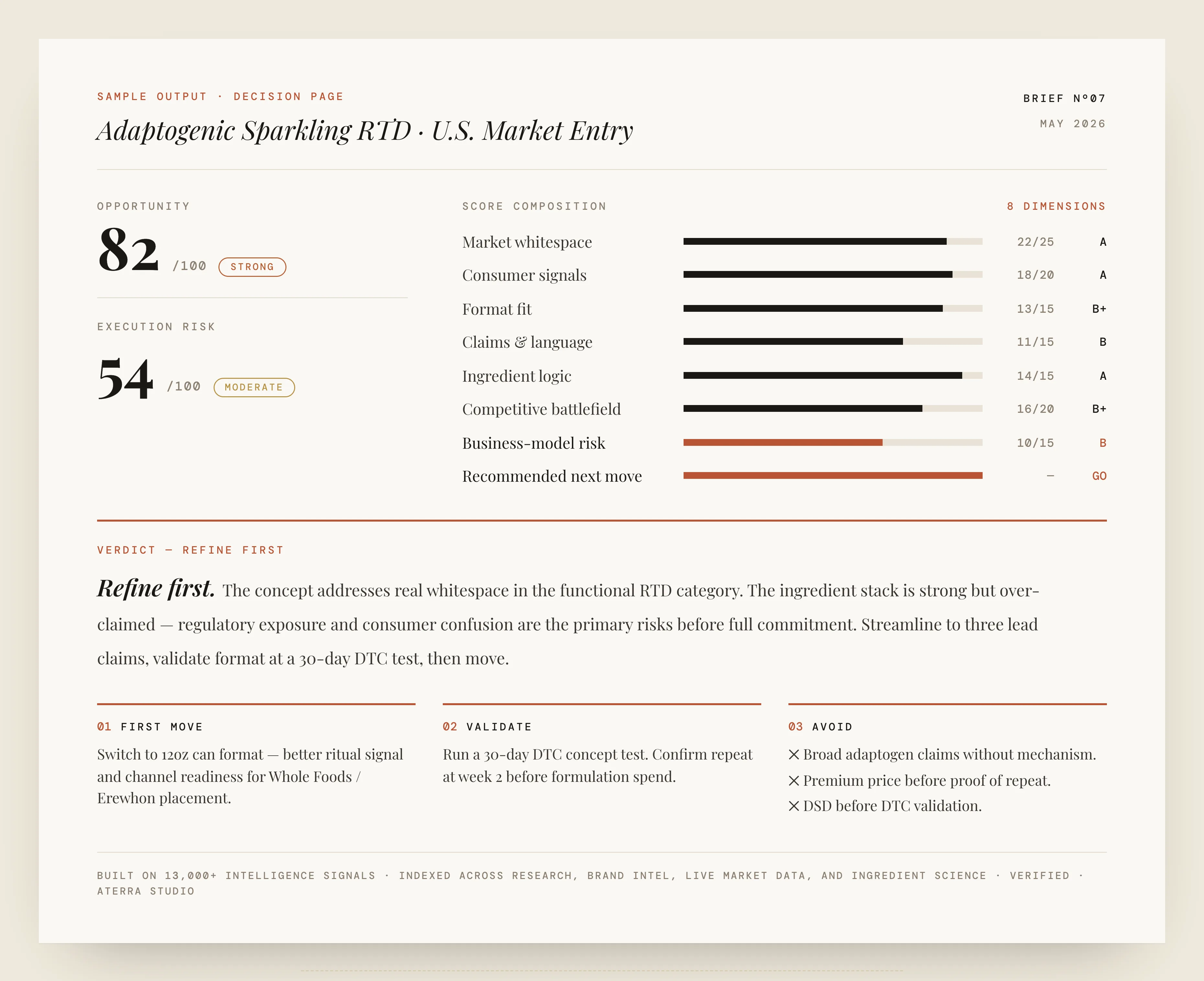
A Gravity brief summary page — the evidence layer feeding the Strategic Decision Brief

The Gravity evidence layer · demonstration concept · see a full sample

Sometimes the honest answer is pause.

Strategic Diagnosis is not a predetermined yes to a decision you've already made. The reading may be that the direction is right but the sequence is wrong — or that something needs proving before more goes in.

06 — The system

Three perspectives. One decision framework.

Market evidence, commercial interpretation, and buyer-facing strategy resolve into a single read — instead of arriving as three disconnected opinions.

How the three perspectives converge into one decision Gravity supplies market evidence, Aterra Studio supplies commercial interpretation, and AP Consulting supplies buyer-facing clarity. All three converge into a single decision: what should lead next. 01 — MARKET Gravity what is happening 02 — BUSINESS Aterra Studio what it means 03 — BUYER AP Consulting what must land THE DECISION What should lead next.
01 — MARKET

Gravity

Market evidence

What is happening in the market, and what evidence supports the opportunity?

  • Consumer behavior
  • Market momentum
  • Competitive activity
  • Retail signals
  • Industry intelligence
  • Category precedent
  • Ingredient evidence
Cross-referenced against 20,000+ classified US market signals. Every finding carries an evidence grade — A, B, or C — and readings are capped when data is sparse.
02 — BUSINESS

Aterra Studio

Commercial interpretation

What does that market reality mean for the commercial and growth decision?

  • Channel strategy
  • Market entry
  • Unit economics
  • Proof architecture
  • Growth sequencing
  • Operational readiness
  • Expansion gates
  • Failure patterns
Diagnose before spending. Prove before scaling. Grow only when the data earns it.
03 — BUYER

AP Consulting

Buyer-facing clarity

What must the buyer understand, believe, and recognize for it to become demand?

  • Buyer clarity
  • Positioning
  • Value proposition
  • Messaging
  • Market-facing comms
  • Marketing priorities
  • Touchpoint alignment
AP Consulting leads the diagnosis and owns the final synthesis, the client narrative, and the professional judgment behind it.
07 — The boundary

What Strategic Diagnosis is not.

✕

Not a general business audit.

✕

Not an execution engagement.

✕

Not another set of disconnected recommendations.

✕

Not a predetermined answer to a decision already made.

It is one consequential growth decision — evaluated properly.

08 — For referral partners

Strategic Diagnosis sits upstream of execution.

It doesn't replace the specialists who execute the strategy. It gives them a clear brief — instead of asking them to set direction while simultaneously delivering it.

Typical triggers
U.S. or new-market entry Retail entry or distribution expansion Scaling Amazon, DTC, or another channel Launching or expanding a product Repositioning the brand Increasing marketing investment Preparing a significant commercial investment Deciding which opportunity leads next
Refer when a client is
  • Evaluating a significant growth investment
  • Weighing multiple strategic directions
  • Entering a new market or channel
  • Launching or repositioning a product
  • Sitting on a growth plateau
  • Unsure what to prioritize before execution scales

The strongest referrals come from partners who hear uncertainty sitting between market evidence, commercial strategy, and buyer clarity — "we're spending more but don't know what's driving growth," "plenty of creative, no idea which message should lead."

The referral model
  1. Identify the company
  2. Identify the strategic trigger
  3. Understand the decision
  4. Identify the uncertainty
  5. Does the decision warrant diagnosis?
  6. Strategic Diagnosis

The ICP tells us who to look for. The trigger tells us why now. The decision tells us what matters.

The referral question

Is this client approaching a decision where greater clarity could change what they commit to, what they prioritize, or what they prove first?

Where referral partners sit

Financial & capital

Fractional CFOs, finance advisors, investors, capital advisors.

Growth & marketing

Fractional CMOs, growth and paid-media agencies, ecommerce and CRO firms.

Brand & creative

Brand studios, creative and packaging agencies, UGC and creator shops.

Distribution & channel

Retail consultants, brokers, distributors, Amazon and wholesale specialists.

Founder ecosystem

CPG organizations, accelerators and incubators, founder communities, operators.

Refer a client → Talk it through first →

Or write directly consultingamberpierre@gmail.com — the company, the strategic trigger, the decision they are approaching, and where the uncertainty sits.

09 — FAQ

Before you bring us the decision.

Who is this built for?+

Founder-led consumer and CPG brands with a product already in market, meaningful activity, and active growth ambitions — food and beverage, wellness, personal care, beauty, fragrance, and adjacent categories. Typically DTC, ecommerce, Amazon, specialty or independent retail, or emerging wholesale, with a lean team where decisions stay concentrated with the founder.

When is it too early?+

When there's nothing yet to diagnose. Pre-launch concepts, no established product, little market evidence, or no consequential decision on the table. The condition is enough evidence to diagnose plus enough uncertainty to require clarity — a purely conceptual brand has neither. At concept stage, a Gravity Scan is the right first read.

When is it too late?+

When the organization is highly institutionalized, with a large internal strategy function and sophisticated decision systems already running. The strongest fit is a company with real product, real activity, and real ambition — but an unresolved decision about what happens next.

How is this different from a Gravity Scan?+

A Gravity Scan is a fast, system-generated read on a product concept — minutes, eight scored dimensions. Strategic Diagnosis is a human-led engagement on a company's next consequential decision. Gravity intelligence is one evidence input; AP Consulting leads the analysis and synthesis. Different question, different depth, different timeline.

What does the engagement look like?+

Activation and intake first — confirming the decision context and the questions that should guide the work. Then diagnosis and evidence development, with a weekly client check-in. A midpoint strategic review at Day 21 presents the emerging diagnosis. Synthesis follows, and the completed Strategic Decision Brief is delivered and presented at Day 45.

Do you execute the strategy afterward?+

No — deliberately. It doesn't include creator outreach, content production, paid media, social management, or implementation. It ends with a white-glove transition to the execution partner best suited to the direction, who now has a clear strategic brief. Further work is separately scoped.

What does it cost?+

Confirmed in the qualifying conversation, once the decision and its scope are clear. This is built for decisions that carry far more financial consequence than the diagnosis does — which is the test worth applying before starting.

What if the diagnosis says our plan is wrong?+

That's a useful outcome. The move is treated as a hypothesis, not a conclusion. The five readings are commit, refine, sequence, prove, or pause — and learning that a direction should be resequenced or proven first is exactly the value.

Who owns what in the partnership?+

AP Consulting is the client-facing party and leads the diagnosis, the interpretation, and the final synthesis. Gravity and Aterra Studio supply the market intelligence, the CPG frameworks, and the commercial interpretation. The founder contracts with AP Consulting and receives one integrated brief.

Is our information confidential?+

Yes. Materials you share are used only to conduct your diagnosis. They are not published, shared with other clients, or added to any public signal set.

Does this include legal, regulatory, or financial advice?+

No. It produces market readings and strategic guidance. Label compliance, FDA requirements, import rules, securities, and tax all need specialist counsel — the diagnosis helps you arrive at those conversations with a sharper read.

How do I refer a client?+

Email Amber at consultingamberpierre@gmail.com with the company, the strategic trigger, the decision they're approaching, and where the uncertainty sits. The conversation starts from whether the decision warrants diagnosis — not from whether the company fits a service.

AP Consulting

Bring us the decision you're weighing.

Fifteen minutes to establish whether the decision in front of you warrants a diagnosis — where you are, what you're considering, and what may need to be resolved before you commit further resources.

The expensive mistake is rarely the wrong tactic. It's committing to a direction that was never the one that should have led.

← Back to Strategic Diagnosis