For years, I thought getting the product onto the shelf was the proof.
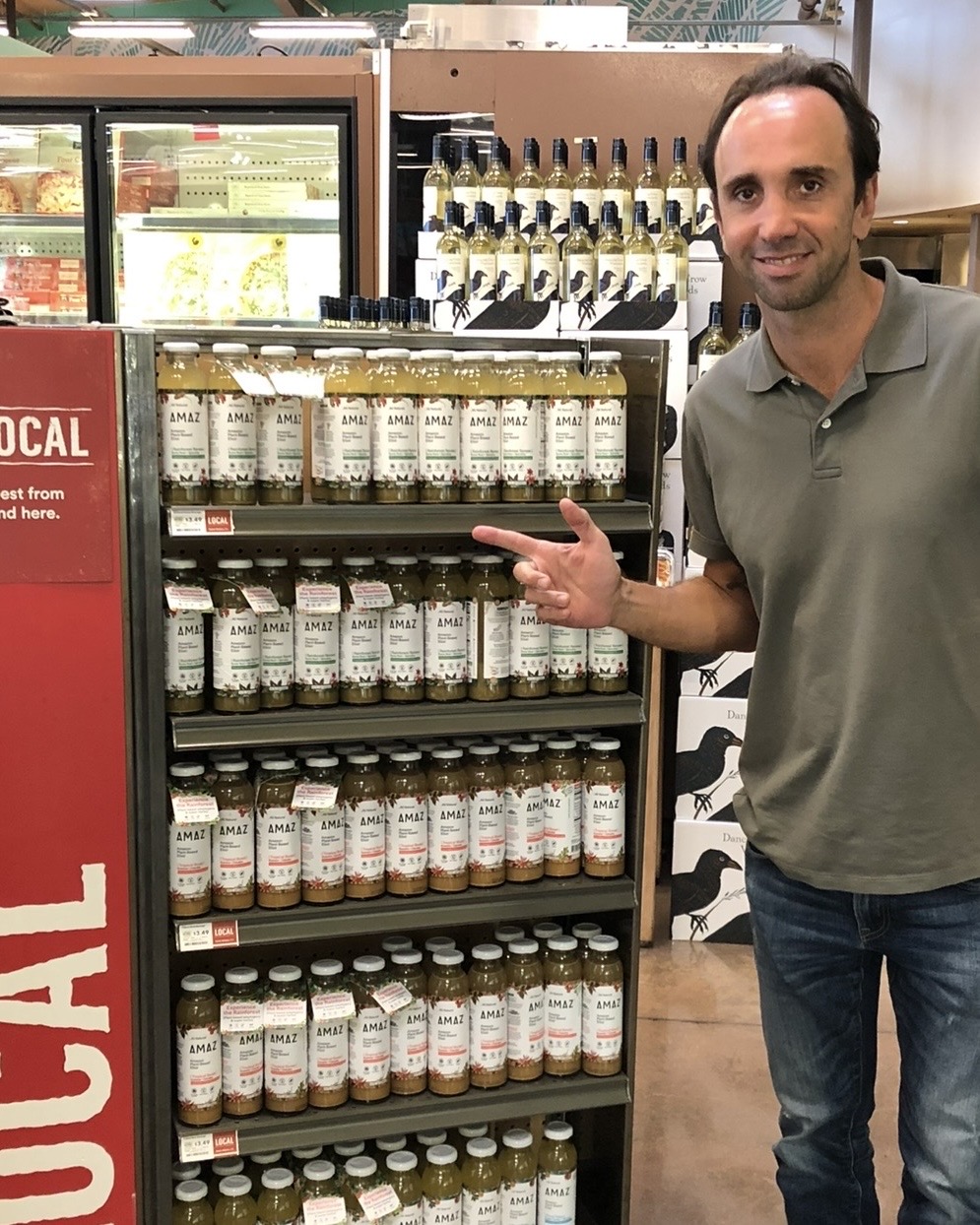
Then Amaz reached Erewhon, Whole Foods Market, and Sprouts Farmers Market — and the questions only got harder.
Did people understand it? Would trial become repeat? Would the economics survive growth?
The shelf wasn't the finish line. It was where the market started telling the truth.
For more than a decade — before that moment and every year since — I've lived inside real CPG launches. Not the version that lives in a deck or a case study, but the parts nobody puts on a slide: a formulation run that won't scale, a broker who goes quiet, a claim that tested beautifully in a focus group and died on the shelf, a reorder that never came.
My instinct as a builder has always pulled toward what could exist next. But the shelf taught me to look past the product itself, and I started searching everywhere for signal — consumer behavior, category movement, retailer feedback, Amazon reviews, competitive launches, repeat purchase. Every piece of evidence I could connect to another.
Trends are loud. Patterns are quiet.
Somewhere in that search, I learned to tell apart two things that look identical from a distance. Trends are loud: the ingredient every launch deck name-drops this quarter, the claim every founder suddenly wants on their pack. Patterns are quiet: what people actually buy, use, repeat, review, and return for, month after month, whether or not anyone happens to be talking about it.
Most of the real opportunity lives inside the pattern. Most of the expensive mistakes come from mistaking a loud trend for one.
That distinction turned into something like an obsession — how do you recognize which ideas deserve conviction before the market makes that call for you, and takes your capital settling the question?
I co-founded Amaz and took it from a concept into premium U.S. retail: Erewhon, Whole Foods, and Sprouts across 400+ doors, plus Gelson's, Bristol Farms, and natural-channel independents from coast to coast. Somewhere in there I also made a specific crossing — bringing a product built with a home-market mindset into the US, the way a growing number of the founders reading this are about to.
What actually breaks a launch
Founders rarely fail because the idea was bad. Most of the ones I've sat across the table from had real instincts — about ingredients, about a gap on the shelf, about a story their category was ready to hear. What broke them wasn't the idea. It was the distance between what they believed and what the market would actually confirm, and nobody caught that distance early, while it was still cheap to close.
By the time it surfaced — in a retail reset, a stalled Amazon listing, a claim a buyer flagged in ten seconds — it was no longer a $500 problem. It was a $50,000 one. Sometimes a company-ending one.
The tools that could have caught it earlier were built for people who didn't need them as urgently as a founder does. A market research firm runs $15,000–$50,000 and takes weeks. A strategy consultant runs $5,000–$15,000 per engagement. A focus group is $20,000 and six weeks you don't have. Every one of them assumes you have that budget sitting idle before you've proven anything — and most first-time and early-stage founders don't. So they skip the read entirely, and find out live, in the market, with their own money.
That's the real problem. Not "founders need more information." Founders need an honest, affordable, fast read on the specific things that break launches, from someone who has actually watched those things break.
What Gravity is, mechanically
Gravity runs on the Aterra Intelligence OS — the same signal-collection and analysis engine I use inside Aterra Studio's own consulting work — pointed at a structured diagnostic framework built from a decade of CPG operating experience, not a generic prompt. It reads for pattern, not noise: whether a signal is a one-off spike or something confirmed again and again across reviews, reorders, and real repeat purchase. Then it carries that read across the dimensions that actually decide whether a concept holds up in-market — consumer language and signal strength, format and purchase-occasion fit, claims maturity, ingredient logic, competitive positioning, and the business-model risk that determines whether the unit economics survive contact with real retail.
It gives readings. Recommendations. Evidence-grounded guidance on where a concept is strong, where it's exposed, and what to check before spending real money. It doesn't hand you the decision — the founder still owns that, the way I owned every real call I made building Amaz. What Gravity does is put evidence underneath the instinct, so the call gets made with something solid beneath it instead of instinct standing alone.
Why I built it the way I did
I could have built a chatbot that answers CPG questions. That's not what this is. Every founder who talks to a well-meaning friend, an advisor, or a generic AI tool already gets opinions. What was missing was a structured diagnostic — the kind an experienced operator runs in their head before green-lighting a launch — made available to a founder writing their own checks, not to a Fortune 500 innovation team.
That's why the top tier, the Reviewed Gravity Brief, isn't an AI report with my name stamped on it. I review and sign every one personally, and it comes with a live hour where we walk the findings together. The system does the heavy analytical lifting. I do the part that fifteen years of watching CPG concepts live or die actually earns: judgment.
Where it stands today
Anyone can ask Gravity a real question about their US market entry for free, no account required. From there, a Gravity Scan runs the full diagnostic for $500 — the founding-cohort rate for what would cost tens of thousands elsewhere — and returns a Gravity Scan Brief. And for founders standing at a launch, retail, or capital decision, the Reviewed Gravity Brief adds my personal review, sharper interpretation, and a direct working session.
Spend follows validation. That's the whole thesis, restated as plainly as it goes.
I built Gravity because I needed exactly that discipline, and it didn't exist yet.
Bring a real question about your US market entry. First one's free, no account required.
Ask Gravity your first question free →
COMMENTS